

The world today is moving faster than ever before and this pace is especially intense in supply chains. Like While companies cannot control all external factors they can gain a competitive advantage by anticipating potential delays before they occur.
This is where HelloProcure Analytics becomes your secret weapon combining procurement data analysis with actionable intelligence to help predict supplier delivery delays and proactively mitigate risk.
Moving Beyond Traditional Procurement Metrics
Gone are the days when shopping analytics was just about tracking spend. Today’s procurement analytics tools allow organizations to examine vast amounts of information, identify risks, uncover performance of patterns, and most importantly, predict supply chain disruptions before they impact operations.
By shifting from a reactive approach to procurement to a predictive, data analytics in procurement, companies can transform procurement from a back office function to a strategic driver of speed and efficiency.
The Problems of Operating in Reactive Procurement Mode
A bunch of organizations still operate reactively, discovering supplier delays only after shipments are delayed or production lines are shut down. This reactive model leaves no room for proactive impact reduction.
Common effects of reactive buying include:
- Overspending: The bottom line is this expedited shipping, downtime costs and late fees.
- Operational delay: One missing piece can throw the entire production line out of whack.
- Reputation damage: Chronic Delivery issues can be detrimental to the brand image.
Data analysis in procurement can transform reactive discretion into proactive solutions spotting and controlling risks long before they impede business.
What Is Procurement Analytics?
Procurement analytics is the practice of using data analysis to gain insight into suppliers, management of procurement, and more.
The key data points that are analyzed using procurement data are following:
- Planned and actual order (PO) dates and delivery times
- Ranking of suppliers (delivery accuracy, quality and lead times)
- Delay history (frequency, duration, root cause)
- Terms of Service and Service Level Agreements
- External data (economic indicators, geopolitical events, climate patterns)
- Internal demand forecasts and production schedules
- Together, these data points allow companies to build a predictive picture of supplier reliability.
From Zero to Predictive Power: How to Forecast Delivery Delays
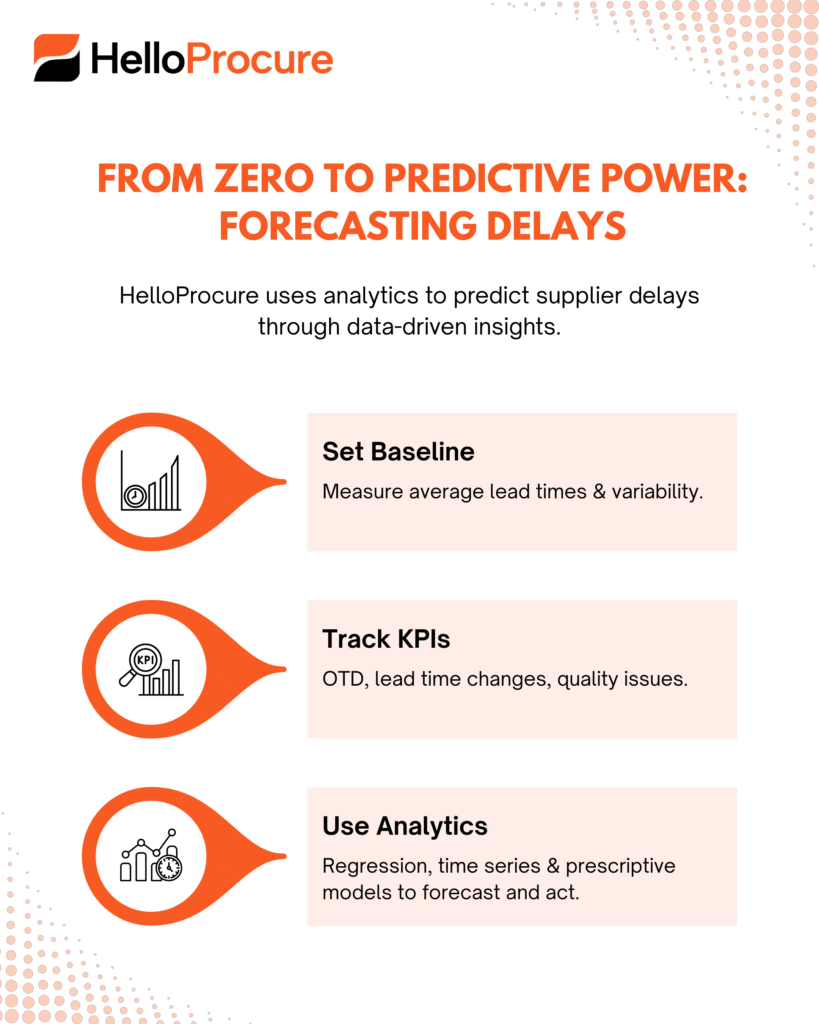
Forecasting supplier delivery delays using HelloProcure Analytics involves building intelligence layer by layer by using robust data analytics in procurement to move from raw data to actionable insight.
1. Establishing a supplier performance baseline
Before detecting anomalies, define what “normal” looks like.
- Average Lead Time: Calculate the historical average time between purchase order issuance and delivery.
- Variability: The general range or rate of change in delivery times. A supplier with a large selection but on-time delivery is a risk.
For proactive monitoring, this baseline helps define performance limits.
2. Determine the risk factors and key performance indicators (KPIs)
Internal KPIs:
The most obvious indicator of supplier reliability is on-time delivery (OTD).
- Change in lead time: The actual lead time differs from the promise.
- Quality incident rate: A high defect rate can indicate unstable PRODUCTION that is a possible indicator of delivery problems.
These metrics, when tracked through data analytics in procurement can highlight suppliers that are prone to unreliability.
3. Utilize Forecasting Analytical Models
Predictive models are used by sophisticated procurement analytics platforms such as HelloProcure to convert these data patterns into precise delays forecasts.
- Regression models: Determining risk factors and estimating performance based on past trends.
- Time Series Analysis: Predicts results using historical data points over time ideal for seasonal demand or cyclical supply patterns.
- Prescriptive analysis: Go beyond expectations and recommend specific mitigation measures such as alternative sources or modified realignment points.
These models are continuously improved with each new data cycle, so the accuracy of the predictions improves over time.
The Future Is Proactive
Leveraging procurement analytics for anticipating supplier delays does more than preventing disruption. its all about building a smarter agile, faster supply chain.
Through the addition of data analytics in procurement, companies shift from reactive to strategic protecting revenue expanding customer satisfaction and preserving business uptime.
Foresight is not a luxury but an imperative in a world of ubiquitous uncertainty. HelloProcure Analytics enables your procurement team to be proactive with smart data driven decisioning.
Final Thoughts
Uncertainty is glimpsed when HelloProcure is combined with data analytics procurement processes. You know WHAT? You can create a truly resilient supply chain by anticipating problems before they arise and continuously learning from supplier performance data.
FREQUENTLY ASKED QUESTIONS (FAQs)
You will need historical data on purchase orders (planned and actual deliveries) supplier performance indicators (exact delivery prices lead times) and inventory levels. Integrate external datasets for advanced forecasting such as geopolitical updates weather trends and supplier financial metrics.
Not at all. While large corporations have complex environments, SMEs benefit equally from data analytics in procurement through affordable, cloud based tools. Platforms like HelloProcure offer analytical features that provide deep insights into spend, supplier performance, and delay risk without massive IT costs.
The accuracy of the forecast is a function of the complexity of the data quality model and environmental predictability. Even not every expert model can anticipate all breakdowns however predictive data analytics based on precious supply pre ordering information enables the identification of high risk suppliers/order prediction with accuracy levels around 70-90%.
- Descriptive: Describes what happened — “Supplier X missed the date on 15% of orders last quarter.”
- Diagnostic: This is why it occurred — “Supplier X had raw material shortages.”
- Predictive: Describes what will be - "There is an 80% chance of"the next order from supplier X will be 3-5 days late."
- Predictive analysis is the basis of proactive procurement planning.
The first step is to identify potential delays. Once marked:
- Evaluation: Evaluate the impact on production, inventory and customer deadlines.
- Communication: Inform internal teams (production, sales, customer service) of the updated schedule.
- Co-location: Consider alternative suppliers, warehouses or expedited logistics to ensure business continuity.
Book a Free Demo of HelloProcure
See how HelloProcure can simplify procurement and ERP integration for your business.
Book My Demo