
Introduction: Why Multi-Agent Approaches Matter
Procurement professionals today are now confronted with increasing complexity, global supplier networks, dynamic risk indicators and ever changing legal and regulatory landscapes. Centralized decision systems of the past can be slow to evolve and fragile in the face of distributed knowledge. Multiple-agent AI, modeled after living swarms, brings you decentralized resilience in sourcing and compliance. This column has described the mechanics of swarm models in procurement, its practical applications, and considerations for design and measurement of success.
What Is a Swarm Model in Procurement?
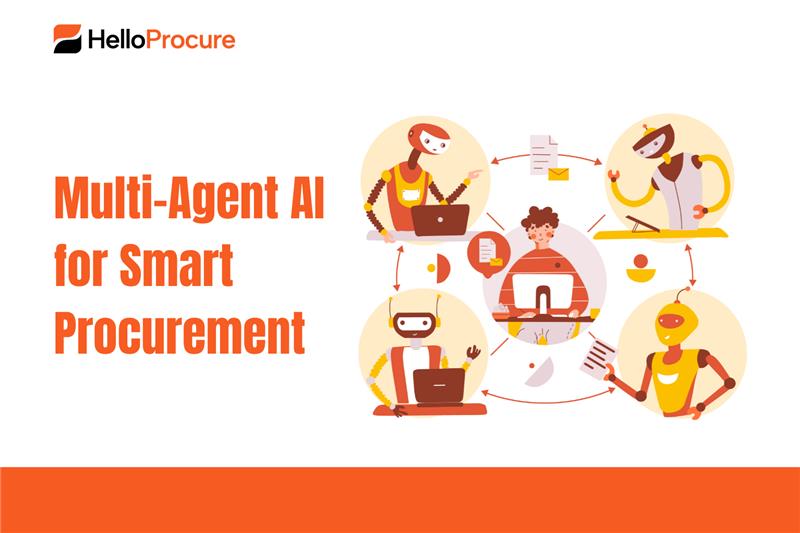
The swarm model consists of a set of autonomous agents which interact locally and whose actions result in the emergence of coordinated behavior. In the world of procurement, agents here can represent roles or capabilities: a sourcing agent scanning for market prices, a compliance-agents crunching on risk, a supplier-performance agent tracking delivery metrics and an analytics-agent pulling together signals. Through communication protocols and joint goals, agents bargain, share information, and converge on sourcing decisions or compliance actions in a decentralized manner.
Key Characteristics
Decentralization: Decisions are made locally, as opposed to a single point of control.
Reactiveness: Agents are reactive and they react to the change in environment conditions at near real time.
Scalable: Other agents or sources of data can be plugged in with only minimal reconfiguration.
Robustness: The system did not collapse due to the failure of agents.
Practical Use Cases for Sourcing
With swarm models, organizations can automate the most time-intensive sourcing activities in an agile, ongoing manner.
Dynamic Supplier Discovery and Selection
MFAs can keep an eye on supplier capability, price trends, lead times and political signals. One kind of sourcing agent spotlights potential suppliers while other agents examine risk and compliance. Collective bargaining occurs when the agents trade off cost, quality and risk preferences to advocate for a ranked short list.
Parallel Tendering and Auctioning
Rather than a linear tender process, several agent teams can run concurrent tenders calibrated for such scenarios as volume shifts, tiered contracts or single-source risks. This reduces time-to-contract while keeping competition between suppliers.
Category Management Optimization
Category agents monitor usage data, demand prediction and contracting terms. When spending trends start to change, agents identify consolidation, rebundling or re-sourcing opportunities to gain more leverage and reduce fragmentation.
Strengthening Compliance and Risk Management
Compliance is frequently a manual, reactive process. Swarm models support rolling, preemptive compliance checks integrated into the sourcing workflow.
Continuous Regulatory Monitoring
Compliance officers swallow regulatory updates, customs alerts and sanctions lists. As a potential match is identified, the agent triggers a context-based alert to source agents so that supplier suitability and contract terms can be re-evaluated.
Automated Documentation and Audit Trails
Agents can oversee the flow of documentation — collecting certifications, contract clauses and proof-of-compliance artifacts. Interactions are logged across the swarm, so audit trails are fine-grained and auditable, minimizing manual reconciliation.
Risk Scoring and Scenario Simulation
A risk agent aggregates supplier performance signals, financial indicators and external events to continuously score vendors. Agents can model supplier interruptions, recommend alternative sourcing strategies and ensure readiness for continuity.
Designing Effective Procurement Swarms
Moving to multicustomer procurement needs carefully crafted design that will align with business objectives and governance.
Define Agent Roles and Incentives
Match core purchasing skills to type of agents (sourcing, compliance, logistics, financial) and their desired results. Incentive alignment is essential: if an agent’s reward is biased toward supplier cost-saving without consideration for compliance, the drift of outcomes ensues. Calibration steers agents to negotiate trade-offs in line with organisational priorities.
Establish Inter-Agent Communication Protocols
Construct lightweight, sturdy rules for communicating messages that allow agents to communicate aspects of their context and to bargain about constraints. Common vocabularies for terms such as lead time, total cost of ownership and risk level minimize misunderstanding and allows for quicker agreement.
Governance and Human-in-the-Loop Controls
Have some humans in the loop for high-impact situations. Define thresholds where human approval is needed and present clear dashboards to explain agent recommendations. humans should be able to interject, to fine-tune agent parameters and audit agent behavior.
Implementation Considerations
A series of successful swarm adoption requires a blend of technology investment, data readiness and change management.
Data Quality and Integration
A quick, reliable flow of information is crucial to agents. Combine supplier records, contract stores, market feeds and compliance databases. Cleanse the supplier master and put in real-time feeds for vital news.
Incremental Rollout Strategy
Begin with targeted pilots—like automating supplier risk scoring or parallel tendering in a single category. Assess impact, iterate agent behaviours and incrementally grow capabilities and populations of agents.
Performance Metrics
You can track time-to-source, cost savings, the number of compliance incidents and diversity metrics. Track agent-level KPIs for recommended acceptance, false positives and median time to resolution on high alert topics.
Common Challenges and How to Mitigate Them
- Silos of data: Knock down silos early by standardizing on inputs and setting up shared data contracts.
- Misaligned Objectives: Balance cost, quality and compliance with explicit multi-objective optimization.
- Risk of Overautomation: Keep human judgment for strategic supplier relationships and corner cases.
- Explainability: We need to invest in agent transparency so that stakeholders can trust the recommendations.
Conclusion: Toward Resilient, Adaptive Procurement
Swarm models and multi-agent AI provide a route for purchasing teams to more agile, dynamic procurement — and one that’s increasingly compliant. By spreading smarts throughout these specialized agents organizations can react more rapidly to market shifts, continually apply compliance, and scale procurement decision making without the bottleneck of centralization. The transition demands thoughtful design, data readiness and governance – but eventually it will result in a procurement function that learns, negotiates and protects value in an increasingly complex world.
FREQUENTLY ASKED QUESTIONS (FAQS)
A swarm model is a decentralized collection of autonomous agents that interact and coordinate to perform sourcing and compliance tasks, producing collective decisions without a single controller.
Multi-agent systems continuously monitor regulatory signals, validate supplier documents, score risk, and generate audit trails, enabling proactive compliance and faster mitigation of issues.
Book a Free Demo of HelloProcure
See how HelloProcure can simplify procurement and ERP integration for your business.